IPS President Kerry Holden reflects on representing the Infection Prevention Society at the APCI Conference on Infection Prevention and Control in Cluj-Napoca, Romania, held in collaboration with the International Federation of Infection Control (IFIC). She shares some of the learning, friendships and international connections she brought home.
After our own fantastic IP2026 in October, I was hopping on a plane to Cluj-Napoca, Romania, to attend the APCI Conference on Infection Prevention and Control, held this year in collaboration with the International Federation of Infection Control (IFIC).
It was a genuine honour to be invited as a guest and to represent IPS. Romania already has a personal connection for me through my brother-in-law and extended family, but this was my first opportunity to experience Cluj-Napoca and my first APCI conference.
A conference to remember
I have been to lots of conferences over the years and inevitably you remember particular presentations or pieces of learning. But occasionally you come home remembering something else just as strongly: how the conference made you feel.
APCI was one of those conferences.
The warmth of our Romanian hosts was extraordinary. The hospitality, the fabulous food, the conversations and laughter around the tables and, yes, quite a lot of dancing! This is something of an APCI tradition. Past IPS President Jennie Wilson reflected after attending an earlier Romanian IPC conference that she too discovered Romanians love to dance.
Cluj-Napoca itself was a joy to visit and somewhere I would happily return to. But what made the visit particularly special was the people. There was time to talk properly, listen to people’s stories, catch up with old friends and make new ones. Increasingly, I think this is where some of the most important international learning happens.
Infection prevention without borders
I also had the enormous privilege of being part of opening the conference as IPS President.
One of the things I talked about was that infection prevention has never been confined by borders. Pathogens do not recognise healthcare systems, organisational structures or political boundaries.
Over the following few days, that stopped simply being a line in a speech and became something I could see happening around me. The programme deliberately brought together international expertise and local experience, which is really at the heart of the partnership between APCI and IFIC.
There were so many programme highlights.
It was brilliant to hear friend of the IPS Claire Kilpatrick speak about improving environmental cleaning through a multifaceted global approach. Claire highlighted the growing range of practical WHO hospital environmental hygiene resources and, importantly, the need to recognise, value and empower the people who clean as essential members of the infection prevention workforce.
This connects closely with the work of the Clean Hospitals programme, which brings together international expertise to improve healthcare environmental hygiene and which IPS plans to work more closely with over the coming year.
Putting people at the heart of IPC
Julie Storr, another past President of IPS, challenged us to look beyond compliance and consider what an optimal IPC service looks like in the real world.
Her session explored compassionate IPC, protecting people from infection while recognising individual needs, dignity and lived experience. She encouraged us to think about proportionate, evidence-informed risk management and to balance infection risk with the wider consequences restrictions can have for patients, families and staff.
It was a powerful reminder that effective IPC is not simply about applying precautions. It is also about thoughtful professional judgement, empathy and working with people to achieve the safest and most humane outcomes.
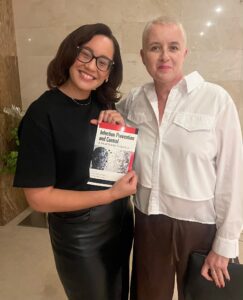
I would also like to thank Julie for the guidance and support she has so generously offered me, drawing on her experience as a past President of IPS. Her thoughtful gift of her book, Infection Prevention and Control: A Social Science Perspective, was especially lovely and will be a valued source of insight as I continue in the role.
Rethinking sustainability and safety
I was also particularly interested in the contribution from Mahmood Bhutta. His work in sustainable healthcare and his longstanding interest in the environmental and labour-rights impacts associated with medical supply chains bring an important wider perspective to healthcare and patient safety.
His contribution reinforced the need to challenge an entrenched single-use culture and, where the evidence and appropriate decontamination pathways support it, consider safe reusable alternatives. It also aligns strongly with IPS support for the new IPC statement on environmental sustainability and its central ambition that patient safety, infection prevention and environmental sustainability are not competing priorities, but intrinsically linked.
It left me thinking again about the questions we increasingly need to ask as IPC practitioners:
Is something necessary? Is it proportionate? What evidence supports it? And can we achieve the same IPC outcome in a more sustainable way?
For me, this isn’t about diminishing our commitment to infection prevention. It is about understanding safety in its widest sense and recognising our responsibility to future generations as well as the patients we care for today.
Learning from colleagues in Ukraine
Perhaps some of the most humbling and inspiring contributions came from colleagues working in Ukraine.
Mariia Dolynska, Head of the TB Department at O.O. Bogomolets National Medical University and Medical Director of Infection Control in Ukraine, shared experiences from work supporting IPC programmes in more than 150 healthcare facilities, including those in frontline areas, since the beginning of the full-scale war.
The programme also included Arkadii Vodianyk from the World Health Organization Country Office in Ukraine, whose work encompasses IPC, antimicrobial resistance, primary healthcare, workforce and service delivery.
Hearing from practitioners seeking to maintain and strengthen IPC while their healthcare system is operating in the context of war puts our conversations about resilience, limited resources and competing priorities into an entirely different perspective.
What struck me particularly was not simply that services were being maintained. People were continuing to learn, improve and contribute to the development of IPC knowledge despite circumstances most of us can barely imagine working within.
It reminded me that the evolution of our IPC evidence base is genuinely international. Some of our most important learning can come from practitioners adapting, researching and innovating in extraordinarily challenging environments.
Perhaps that was one of my biggest reflections from Romania: international collaboration requires as much listening as it does sharing.
From data to change
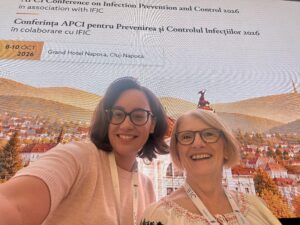
One of my personal highlights was delivering From data to change: how to turn infection prevention auditing into action with Carole Hallam.
We wanted from the outset to make the workshop practical and participative rather than simply delivering another presentation, so we even flexed our amateur drama skills!
Working alongside Carole made it particularly special. Carole has supported IPC training and education in Romania voluntarily since 2005 and is an honorary member of both APCI and IPS.
Building an international IPC community
IPC can feel like quite a small international family. You meet somebody at one conference, reconnect somewhere else, collaborate on something later and, before you realise it, those professional connections have become genuine friendships.
As President, one of the things I would like us to explore is how we turn those international relationships into something meaningful for IPS members.
Relationships where societies share resources, evidence and learning. Where practitioners can connect with colleagues facing similar challenges elsewhere in the world. Where we learn from different approaches and support one another when circumstances become extraordinarily difficult.
Our Vice President, Jo Taylor, will be supporting me in developing those connections with IPC societies across the world. I would love this to become an increasingly visible and useful part of what IPS does.
Towards the end of my opening address, I encouraged everyone to be curious, be generous with their knowledge, challenge assumptions and make new connections.
Looking back now, APCI gave exactly that back to me.
I travelled to Romania honoured to represent IPS and hoping I could share something useful from our experiences. I came home having learnt just as much from everyone I met.
So, a huge mulțumesc, thank you, to our APCI friends for their incredible hospitality and warmth, to IFIC for helping bring our international community together, to Carole Hallam for being such a fabulous workshop partner and tour guide, and to everyone who shared a story, an idea, a meal, a laugh or a dance with us.